Table Of Content

PRP contains special cells called platelets that can cause hair follicles to grow by stimulating the stem cells and other cells in the hair follicle’s microenvironment. These platelet cells promote and accelerate tissue healing and regeneration. PRP also helps stimulate inactive or newly implanted hair follicles into an active growth phase. The rate of hair loss may increase noticeably if the hair roots are damaged during the growth phase or if a lot of hairs go into the resting phase at the same time. If no new hair grows and replaces the hair, that part of the skin becomes bald.
What kind of results can I expect after ACell + PRP Hair Regrowth Therapy?
The hair is gradually pushed out of the skin and eventually falls out. The shaft is the visible part of the hair that sticks out of the skin. The hair root is in the skin and extends down to the deeper layers of the skin. It is surrounded by the hair follicle (a sheath of skin and connective tissue), which is also connected to a sebaceous gland. Until recently, the IP of the hair follicle is considered to be restricted to the matrix region during the anagen phase.
What health conditions can affect my nail matrix?

The hair follicle is comprised of layers of cells that work together to support and form the hair shaft. The hair follicle is a dynamic organ that is constantly growing and regenerating. New hair is produced at the base of the hair follicle, and the old hair is pushed out of the follicle and shed.
The Structure and Growth Cycle of Hair Follicles
WNT10b mainly plays a role in the mammalian hair follicle cycle and is highly expressed during anagen of the hair follicle, thus promoting epithelial differentiation and early development of hair follicles (Bai et al., 2021). During telogen, overexpression of WNT10b can induce hair follicles to change from refractory phase to inductive phase, thus entering anagen (Hawkshaw et al., 2019; Liu et al., 2021). WNT3a is mainly expressed in root sheath progenitor cells, bulbs, hair bulges, epidermis, melanocytes, and melanin stem cells in hair follicles. Chen et al. (2015) found that the expression of tumor necrosis factor α (TNF- α) increased after hair removal, while TNF- α related peptides could significantly stimulate keratinocytes to express WNT3, WNT10a and WNT10b. TNF- α promotes hair regeneration by activating the NF- κB signaling pathway and finally activating the WNT signaling pathway.
11 Best Keratin Shampoos (Tested & Reviewed for 2024) - Cosmopolitan
11 Best Keratin Shampoos (Tested & Reviewed for .
Posted: Wed, 01 Nov 2023 07:00:00 GMT [source]
How does ACell work and what are its benefits?
A thorough history, physical exam, hair pull test, daily hair counts, part width, clip tests to examine the hair shaft, hair growth windows, and hair pluck, and trichograms can all be used to diagnose hair disease. Scalp biopsies, hormone studies, and a potassium hydroxide examination for fungi may also need to be performed in certain cases. It is important to diagnose hair disease correctly, as the treatment for hair loss is dependent on the diagnosis. It is a fine membrane which covers the outer surface of the skull. It has 2 distinct layers; the fibrous layer (outermost) and the cambium layer, which is the innermost layer.
At the end of this phase, which lasts about 2 to 4 months, another anagen phase begins. The basal cells in the hair matrix then produce a new hair follicle, which pushes the old hair out as the growth cycle repeats itself. Hair typically grows at the rate of 0.3 mm per day during the anagen phase. Hair loss occurs if there is more hair shed than what is replaced and can happen due to hormonal or dietary changes. Hair loss can also result from the aging process, or the influence of hormones. The typical characteristics of hair follicles entering catagen are that HS stops growing, cell proliferation and differentiation ability begins to decline, cells begin to undergo apoptosis, and hair follicles rapidly degenerate.
What does my nail matrix do?
Hair development is a continuous cyclic process and all mature follicles go through a growth cycle consisting of growth (anagen), regression (catagen), rest (telogen) and shedding (exogen) phases (Figure 3). The duration of the phases changes based on the location of the hair and also personal nutritional and hormonal status and age [15, 33]. Thus hair follicle IP is limited to the proximal epithelium of anagen hair follicles. During anagen, melanogenesis is activated in the hair bulb and suggests that hair follicle melanocyte autoantigens play a key role as potential immune targets [28, 31].
Hair structure
A bulb of keratin attaches to the bottom tip of the hair and keeps it in place while a new hair begins to grow below it. A hair pulled out in this phase will have the bulb of keratin attached to it which appears as a small white ball on the end of the hair. This process cuts the hair off from its blood supply and from the cells that produce new hair. When a club hair is completely formed, about a 2-week process, the hair follicle enters the telogen phase.
Hair follicle stem cells are thought to reside in the bulge area on the isthmus close to the insertion of the arrector muscle [20]. Lineage studies have proven that bulge cells are multipotent and that their progeny generate the new lower anagen hair follicle [21]. One of the most distinguishing features of stem cells is their slow-cycling nature, presumably to conserve their proliferative potential and to minimize DNA errors that could occur during replication.
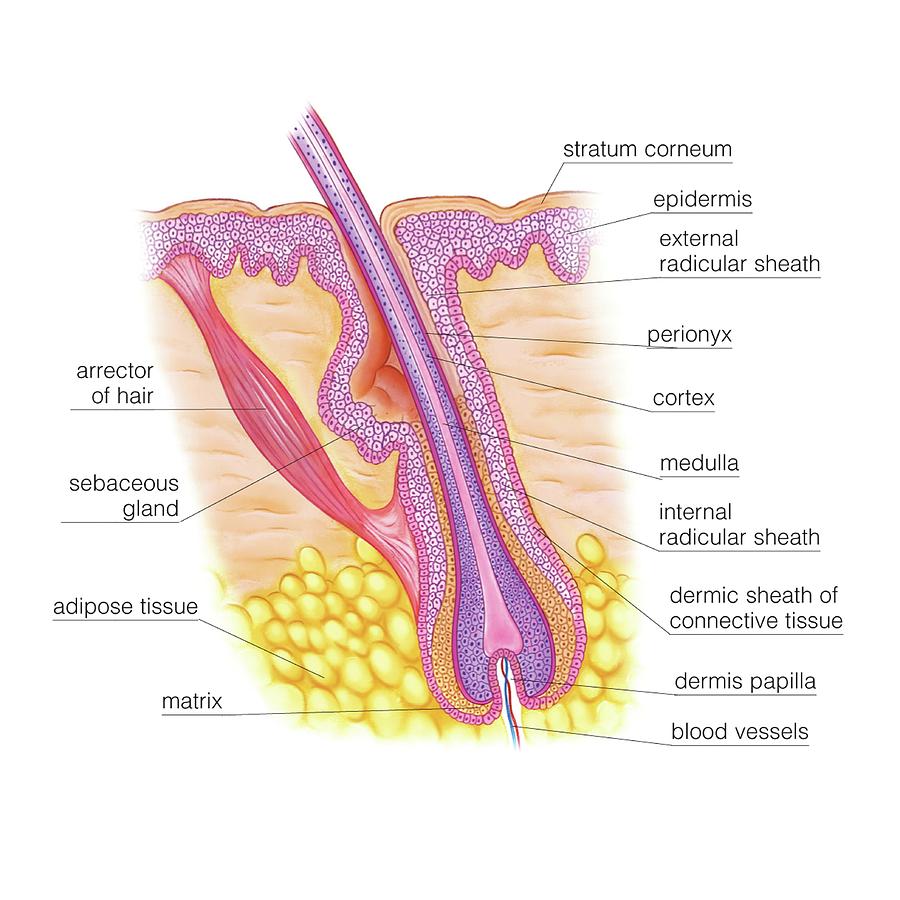
The first sign of catagen is the termination of melanogenesis in the hair bulb. Follicular epithelium, mesenchyme, neuroectodermal cell populations and also perifollicular vascular and neural systems demonstrates cyclic changes in differentiation and apoptosis. However, any apoptosis is occurred in dermal papilla due to the expression of suppressor bcl-2 [11]. The infundibulum, the uppermost portion of the hair follicle extending from the opening of the sebaceous gland to the surface of the skin, is a funnel-shaped structure filled with sebum, the product of the sebaceous glands. The upper part named acroinfundibulum, the keratinization of epithelium turns into the “epidermal mode”, with formation of stratum granulosum and stratum corneum like a similar manner to epidermis [1, 14, 16].
The process takes about 90 minutes, and recovery is quick, with minor soreness in the scalp that typically subsides within 48 hours. These results last for months, and even years, before regression may begin to occur. Creating a comprehensive plan and maintaining an ongoing relationship with Dr. Kang will ensure you know the ideal time for your next procedure to keep your hair growing and thriving. The details of these elements and further information regarding the epidermis can be found here. If you are experiencing hair loss, it is important to see a dermatologist.
Hair texture (straight, curly) is determined by the shape and structure of the cortex, and to the extent that it is present, the medulla. The shape and structure of these layers are, in turn, determined by the shape of the hair follicle. Hair growth begins with the production of keratinocytes by the basal cells of the hair bulb.
Hair shaft pigmentation ensures multiple benefits including UV protection, thermoregulation and sexual perceptions. Furthermore, the hair pigment, melanin, is a potent free-radical scavenger. Melanin production inside the active anagen hair bulb may, therefore, help to buffer cell stress induced by reactive oxygen species. In summary, the formation of placodes in response to the first dermal signal involves activation of EDA/EDAR signaling in the epithelium, followed by epithelial WNT signaling, and subsequent activation of BMP signaling.
The hair follicle is a skin appendage located deep in the dermis of the skin. Your healthcare provider can tell you whether it’s a nail matrix problem or some other issue. Let your provider know if you notice any nail changes, from a small spot of color to lines or ridges. Once your nail matrix heals, your nail will usually start to grow again.